




The highly anticipated launch of the 2025 Yamaha YZF-R9 hasn’t disappointed around the world. Already winning in World Supersport and MotoAmerica, it looks like we’ll be seeing it at the front of most national championships. It shouldn’t surprise you or me that the day we spent testing the new bike at Sonoma Raceway in Northern California didn’t come up short, either. I got the honour of spinning laps on the stock bike to see if it lives up to the racing hype!
We got dealt a tough hand weather wise with a wet track for most of the day, no surprise for Sonoma Raceway in March. I ended up sneaking out for five laps on a mostly dry track with proper tires at the end of the day, but all the other laps were on a fully wet or damp track using rain tires. I’m a glass half full guy, though, I was ready to have fun no matter the conditions.

A wet track can actually be a blessing when it comes to testing a new bike, lending an opportunity to uncover its capabilities in the toughest conditions. In the racing world, when you have your chassis setup nailed and really neutral, you can soften everything a little bit and the bike works great in the rain. When your dry setup isn’t balanced, it might be fast in the dry and suit your style, but the rain can be a survival experience. Engine and brakes can be pushed harder in the dry obviously, but you still get a good idea of their temperament from the wet testing. Evaluating electronics can be done well in the rain, especially the traction aids that are under the microscope on a track with less grip. I find evaluating ergonomics is better in the rain, because trying to keep the bike calm requires smooth and efficient movements that point out any flaws in the bike’s comfort. All in all, rain made for a great situation to evaluate the new bike.
Ergonomics
Yamaha nailed the ergonomics on this bike, along with the adjustability offered in stock trim. One of the first things I was excited to get a feel for was rider triangle knowing that I felt cramped back in the day racing an R6, but I was pretty comfy on the R1 in recent years. I was pleasantly surprised to find out the new bike was closer to the R1 comfort than the R6 for me, with a really clean rider triangle. You feel like you’re sitting more “in” the bike with less weight on your hands, compared to the R6 I always felt I was sitting “on” the bike with a lot of your body weight thrown forwards.


Yamaha aimed for the ergonomics to land between the R6 and R7, so if you’ve ridden both of those bikes, you have a good reference point. Bars are adjustable clip on style, and come in a great open setting from factory. The rear sets felt like they were in a really good spot out of the box, and feature two options in the frame if you want them in the high or low spot (we ran them in the low setting). Another cool adjustable feature on the R9 is the ability to swap the quick shifter from street pattern shift to GP pattern with only a couple wrenches.
Chassis
The R9 isn’t just well balanced, but it handles like a proper race bike using a new chassis Yamaha created to work with the CP3 triple engine. Yamaha explained they focused on a great street bike first, and wanted it track capable from there. They went all in on this new frame and swingarm with a development team including ex-MotoGP Engineers. The only piece other than the engine they plugged in directly from the MT-09 “sibling” (as I like to call it) of the R9 is the subframe; but the frame is brand new, and the swingarm got some tweaks. They chose to use the same wheels as the R6 after testing showed they handled the high load scenarios best.
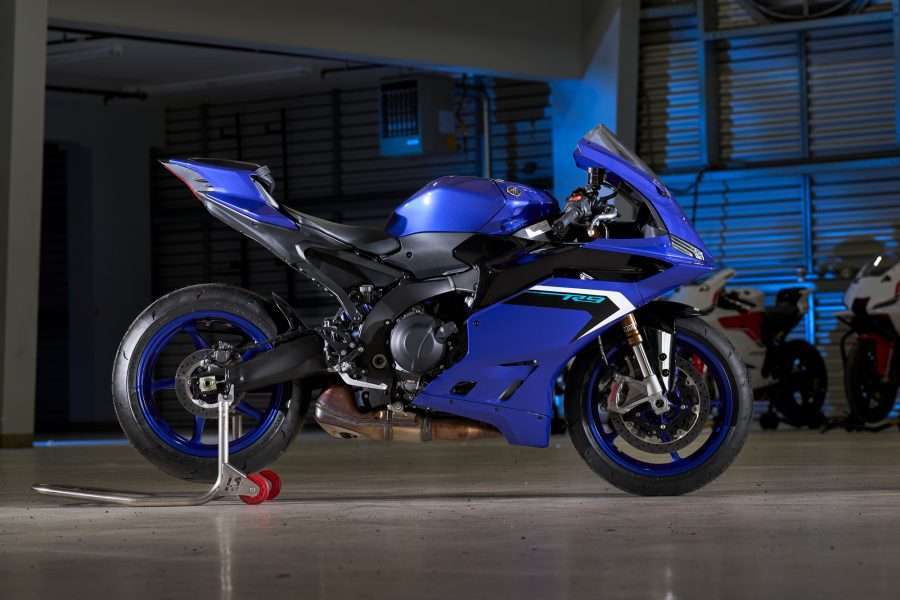
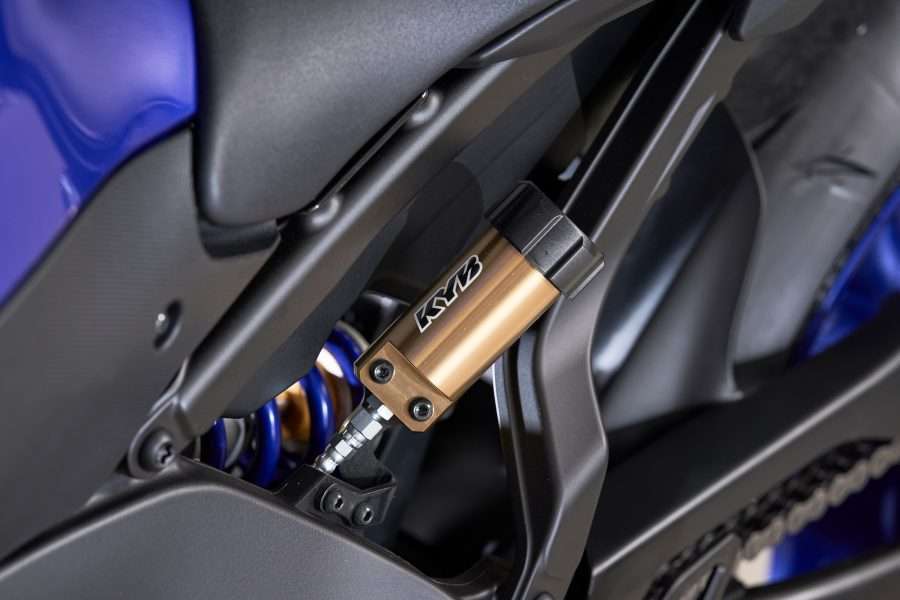
They even opted to outfit the bike with fully adjustable KYB front and rear suspension, so everyone can easily tweak the suspension settings to their liking. It’s obvious Yamaha wanted to develop a bike to shine at the top of its class, and they didn’t pull any punches in doing so. Some of the chassis numbers aren’t “typical” for a race bike, with a tighter than usual rake and small trail number, but the Engineers encouraged us to just ride it and be open minded because the bike handles great – and they weren’t wrong. They were emphatic that their focus was on rideability and balance, and I think they found both. Perfect characteristics for a street focused bike, and a great launching point for any race bike to start at.
The Yamaha Engineers and test riders did a proper job getting the base settings right for Sonoma before our day of riding, so we had a great base setting to evaluate. They dialed in the KYB forks and shock, which feature some fancy touches. Forks have independent damping with compression on the left leg and rebound on the right, featuring valving developed at the race track in Japan. The KYB shock fitted to the R9 has some trick super low speed valving to keep smooth transitions during on/off throttle, and it was quite noticeable in the rain keeping the chassis super settled in these transitions. I didn’t have a single “moment” getting on or off throttle, which is rare in the rain, normally you can find a bit of wiggle in a transition or two.
I always found 600s to be a bit twitchy, and give a ton of that feedback through the bars and pegs, but the R9 didn’t do that for me – the feel and feedback through the bars and pegs is really solid and reminds me more of a litre bike. Very confidence inspiring chassis everywhere on the track. Josh Hayes was with us at Sonoma as he continues to serve Yamaha as an Ambassador, and he wasn’t lying when he said this is the most stable stock bike on the brakes he’s ever ridden.
The R9 had a really planted front end feel on corner entry, tons of feedback from the front tire to get to apex easy, and still finished corners without much trouble. The bike changed directions well and didn’t pitch hardly at all on acceleration or brakes. You might be thinking that’s easy to feel when you’re tip toing around in the rain, but on the drying track conditions we were going pretty hard – and the few laps I got to turn in the dry gave me the same conclusions. I didn’t even mess with clickers it was working so well.
Handling was typical of a bike with tight rake, but not an extreme case, and I believe it’s in a spot where you could easily go a few directions on setup to find success for different riding styles. A good baseline for the racer to mess with, and an exceptional baseline for the street or track day focused rider. Overall, really impressive balance for a stock machine.
Aerodynamics
When it comes to chassis performance, one of the coolest features coming stock on sport bikes these days is winglets. Manufacturers have come a long way with understanding aerodynamics on bikes the past decade, and most winglets these days are not just for looks, but performance. The R9 has some tasteful winglets that look great and also function to improve downforce 10%, helping stability at speed and agility at lower speeds. The new bike not only looks unreal, but the R9 is the most aerodynamic R model Yamaha has ever brought to market. I’m always impressed when a model can look great and check off boxes like this, too.

Engine
The next piece of the puzzle for a great new bike; give us an engine that keeps us smiling ear to ear every time we ride. Yamaha already knew they had the engine piece of the puzzle solved, and opted to use a proven weapon from their arsenal by plugging in their widely known and loved CP3 triple. They did have to make a couple tweaks, notably a specific ECU compared to the MT-09, and the R9 borrows the large curved radiator from to the R1 to help with cooling.

The 809 cc powerplant has all the characteristics of a triple that our motorcycle World has come to love. Tons of torque, great sound, and a usable power band. If you want to use past experience riding an R6 as a reference point, picture an engine with the same peak power, but 40 percent more torque over a way wider range. The engine doesn’t rev like an inline-four, but it doesn’t have to – the torque numbers get you moving with ease. Whether you’re doing most of your riding on the street or track, you should fall in love with this engine.
Brakes
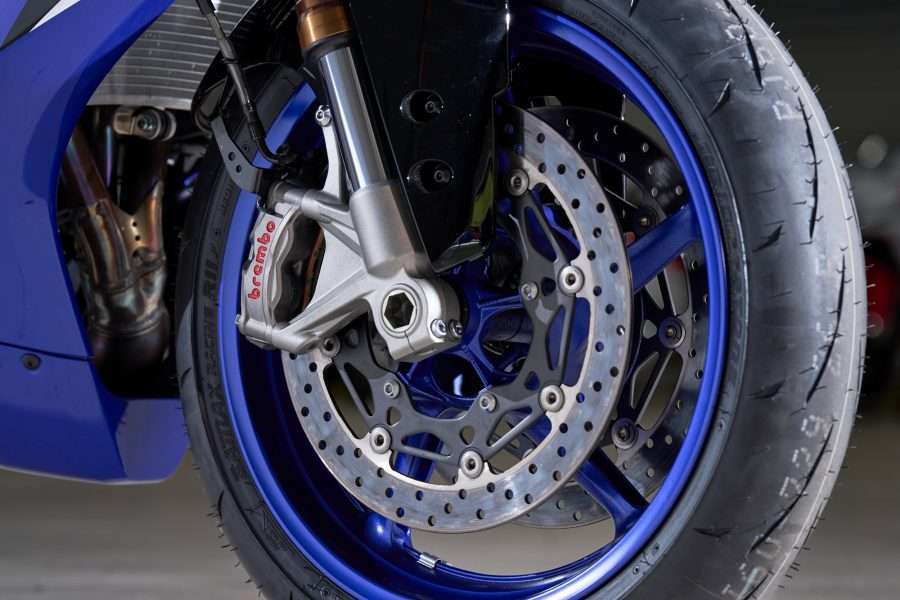
Stopping the bike is made easy using a Brembo master cylinder and Brembo Stylema monobloc calipers up front, with steel braided lines to top it off. The calipers feature a new design to cool the brake pads better, and the steel braided lines should also help mitigate brake fading. Obviously not a hot day to test the brakes under extreme stress, but we had some hard braking zones to evaluate their capabilities and I can confirm the bike has a ton of stopping power.
Electronics
On the software side of things, Yamaha has no trouble in my opinion. The electronics fitted on the R9 have been refined yearly on other R machines, along with the controls and dash interface. You’ll find the same six-way inertia measurement unit (IMU) that Yamaha’s track focused bikes have had for years now, and it continues to impress. Engine power mode, traction control, slide control, wheelie control, engine brake control, launch control, back-slip control, quick shifter for up and downshifts, and ABS all come stock with a scale of settings on each feature to refine the electronics setup you’ll need. It even has cruise control for those long highway rides, and GPS for navigating!
The R9 has three pre-set riding modes (Sport/Street/Rain), and then you have the ability to build custom and track specific modes to jump between for quick electronic changes. All of this is done on a gorgeous dash with display options you will be sure to drool over, especially if you still remember riding old school analog dashes. Dash control is made simple with a really neat four-way joystick on the left handlebar. The R9 is compatible with the Yamaha Motorcycle Connect app, and Y-TRAC Rev app which acts as a data logger for all the stock sensors on the R9. The Y-TRAC Rev app is pretty incredible, having riding data available on your smartphone is convenient and a big help for improving on the track.
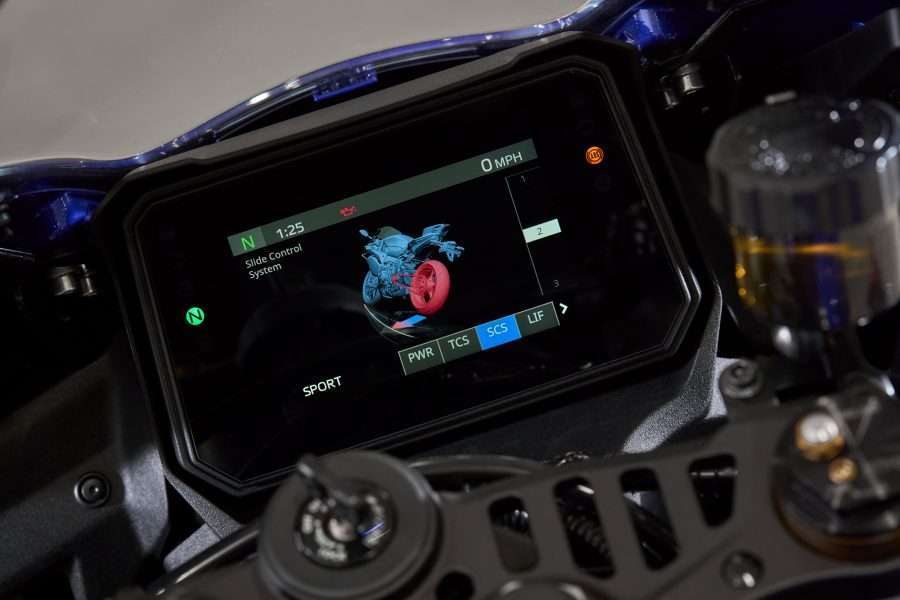
Traction control has nine settings, and I ran it on the higher settings most of the day without issue of it feeling too overpowering. I liked having that safety net, and similarly with the slide control having three levels I kept it turned up to 2 or 3 for most sessions. I rode the bike for a handful of laps with everything turned down a lot more and noticed it helped liven the bike up, which is what you’d expect with the electronics freeing up the power, but it still had the ability to keep the bike in line moving the right direction. Like I mentioned earlier, Yamaha has their electronics package dialed, and the R9 comes with everything you’ll need to have some safe fun on the street and track.
The new YZF-R9 is living up to the hype, and it will be fun to follow along its journey in the Yamaha offering over the years. Yamaha wanted an ideal balance of accessible performance for the street, and useable performance for the track, and I think they’ve accomplished that. It’s great to see a manufacturer get so many things right on the first try when developing a bike from the ground up. I’m hoping to get another chance to ride one for a day in the dry this year, and will report back any findings!
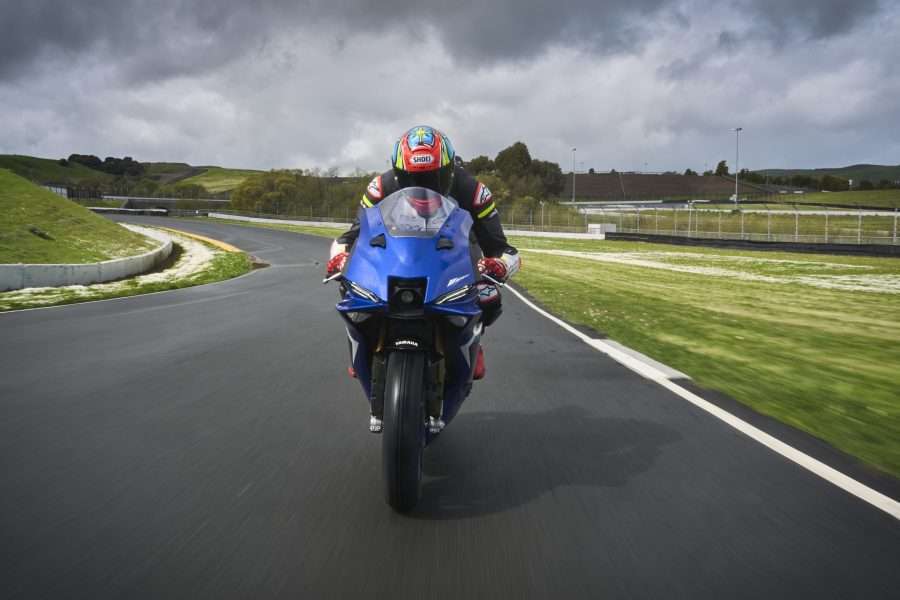
2025 Yamaha YZF-R9
- Suggested Retail: $15,999
- Colours: Team Yamaha Blue, Matte Raven Black
- Engine: Liquid-cooled, three-cylinder
- Displacement: 890 cc
- Bore & Stroke: 78.0 x 62.1 mm
- Compression Ratio: 11.5:1
- Power: n/a*
- Torque: n/a*
- Fuel Delivery: Fuel injection
- Final Drive: O-ring chain
- Weight: 195 kg (430 lb) wet
- Transmission: Six speed
- Frame: Lightweight supersport cast aluminum frame
- Wheelbase: 1,420 mm (55.9 in)
- Seat Height: 830 mm (32.7 in)
- Suspension (front): 43 mm KYB inverted fork, adjustable preload, high/low speed compression and rebound
- Suspension (rear): KYB single shock, adjustable preload, high/low speed compression and rebound damping
- Tire (front): 120/70 ZR17
- Tire (rear): 180/55 ZR17
- Brakes (front): Dual 320 mm discs with Brembo Stylema monobloc four-piston calipers
- Brakes (rear): Single 220 mm disc with single-piston caliper
- Fuel Capacity: 14 L
*While neither Yamaha Motor Canada or Yamaha Motor Corporations, USA have disclosed claimed horsepower or torque for the 2025 YZF-R9, it has been widely reported that the CP3 powerplant in the R9 produces 108 horsepower and 63 ft-lb of torque. – Ed.


