Steve Dick is a very young looking 70 and has always presented as youthful. At the event considered to be the first-ever National Superbike competition in Canada for what is now called Bridgestone CSBK, Dick was 25, but certainly didn’t look it. I can say this since I was there too, working for “Cycle Canada.”

Dick was known as a local fast guy, attracting attention with a pure bred, home built racer powered by a Can-Am sourced Rotax two-stroke powerplant. But Dick’s big first impression was made aboard a fearsome Honda CBX1000 six-cylinder, near stock street bike. He would up placing second at Edmonton International Speedway’s opening Superbike National, beaten only by eventual Champ George Morin’s more conventional Kawasaki.

Now retired and spending his winter in southern Baja, Mexico, after marrying Darlene last summer, Dick recently spent some time discussing his lengthy career and upcoming induction into the Canadian Motorcycle Hall of Fame in British Columbia. Steve plans to summer back “home” in BC after spending much of his life moving across Canada; he now lives close to the Area27 course in Oliver.

The Canadian Motorcycle Hall of Fame will stage their 17th annual induction event at the Aria Convention Centre in Surrey, British Columbia, on Saturday, February 15. Tickets are available at: MClegends@aol.com.
Dick started riding at age 14, as was legal in Alberta, aboard a Suzuki 50 street bike – he got his licence the day he turned 14. Soon he moved up to Honda’s CB100, purchased from eventual supporter Alberta Cycle: “I didn’t know anything about mechanics, but boy, I learned. By the time I was 20 years old, I was well-versed.”
In the Spring of 1976 Steve had a 1973 Kawasaki Z-1 900 cc street machine, the top bike of the time and a machine he would end up racing against often. He went to the Edmonton International venue to take part in a Friday night A.R.C. (Alberta Roadracing Club) event run by the Faheys, the very active organizing spouse team of Jim and Sukoshi.
“The fast guy at the time was Nathan Naslund (eventual executive with Suzuki Canada and Harley-Davidson), he had a modified single cam Honda CB750. There were three classes, and in the first race I was close to last, then next one I wound up mid-pack, and then in the last race I was second behind Nathan.”
Key to the very rapid progress of Dick was another colorful character from the A.R.C., Bruce Cherwonka, club V.P.: “Bruce and a group of his friends took me under their wing, to say the least. Bruce lived near the track, and I went to his place and borrowed some leathers, and back at the track his friends were getting my bike ready, doing the lock wire, that kind of thing.”
“My next race was Edmonton’s CMA National, and at that time the stars of the show were the Yamaha Motor Canada team of Steve Baker and tuner Bob Work. I watched Steve, got to see how he was riding those factory bikes, and really, it was like art. So now I knew what I wanted to do.”
From there, Steve joined the more experience pair of Brien Smith and Cherwonka to head way east to St. Felicien in rural Quebec to compete in the final National of 1976. By the end of 1977 Dick was promoted to Expert status with the CMA National sanctioning group.
“I got a Yamaha RD, it was the bike to have, and in my first race I was first into the first corner in Edmonton and I never looked back. Back then, everyone was really twisting the rules a bit, so the Westwood track in BC had a big money race for the 400s.”
At the time, Edmonton had an active Women’s class, and Dick borrowed Colleen Collins Yamaha for the BC race.
“I won that race,” comments Dick of the big money lightweight invitational, a notorious event in Canadian racing history, in an era before the country was unified for bike competition. “After the race, they ended up disqualifying all but one rider down to sixth, and the race paid down to sixth!”
From there, Dick started work on his unique Can-Am powered monocoque racer, a machine way ahead of it’s time, constructed completely in Alberta.
“We had big brakes, anti-dive, low unsprung weight, low fuel tank, rear brake on the countershaft,” explains Dick. “We started with a 250 cc Rotax rotary valve two-stroke single cylinder engine, a Motocross powerplant. I ended up spending around $10,000, and I could have purchased a Yamaha TZS250 for much less than half of that. But we learned so much, both in terms of engineering and the powerplant.”
“The bike was built to get around Edmonton quickly, so it was ideal for our bumpy Canadian tracks. After sorting things out with builder Brian Hanson, we switched to a 175cc Can-Am engine, meaning we could race in the 125 cc Grand Prix category. Development was helped with races at the fast and rough temporary track at Dewitt Airport in Beaverlodge, west of Calgary.
“We had seizures all the time, we had the cylinder reversed on the cases, and we couldn’t figure out what the issue was. But at Dewitt, on that long straight, I could feel the bike get lean, and I could tell it was starving for fuel. One of the local racers lived nearby, and we got a vacuum-operated fuel pump from a sled at his house Saturday night, and then I was winning everything.”
In 1980, a revision in the CMA National rules meant that three classes of Expert level racers were eligible for the overall number one plate: 250 cc Grand Prix, 500 cc G.P. and the new-fangled Superbike category.
“I had lived briefly back east in Toronto with my dad in 1979 but came back to race in Alberta for 1980. Alberta Cycle got a deal from Honda Canada on that CBX, and I met Bob Sweet, who built the bike. He had a nice, somewhat built Suzuki GS1000, and we would run around on the street together.”
Dick’s efforts were a shock to the Ontario racing establishment, since he was Alberta based and no one serious raced the CBX. He was expected to flounder when the second and last National took place at Shannonville in September, but a solid sixth meant he wound up third overall in the National Superbike standings.
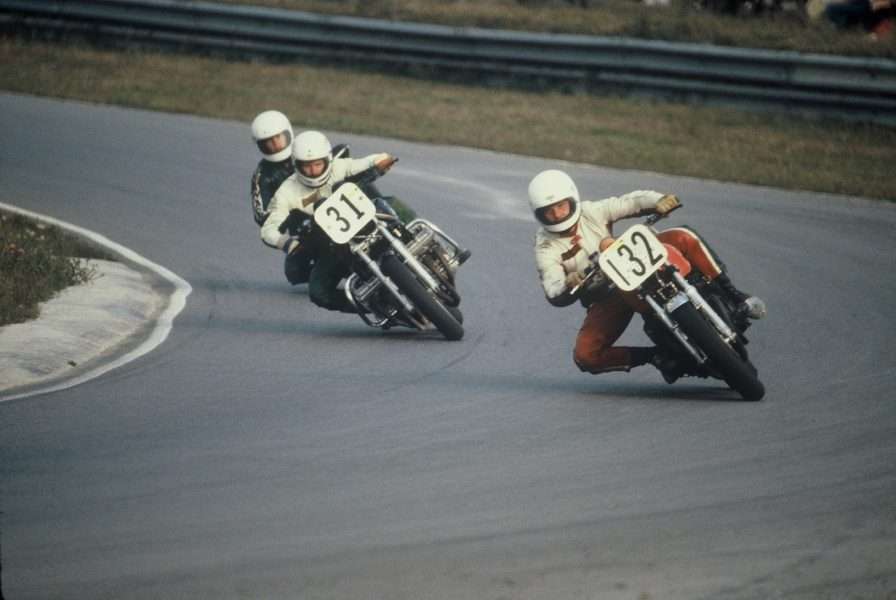
For 1981, Dick pondered a moved to BC for better weather and a base near Westwood but instead made an intermediary step to Calgary. He made a deal with Kawasaki to race the new KZ1000 “J” model provided by Blackfoot, complete with a twin-spark plug kit engine, a similar set-up to what Lang Hindle used with his number one with the new upstart RACE Eastern Canada Championship.
Dick was part of a small group that chased the CMA class tiles and earned the Superbike crown in 1981 and 1982.In 1982 Dick was finally BC based, with KZ Superbike machinery provided by Burnaby Kawasaki.
“We had good contingency support,” remembers Dick. “We had lots of success in Alberta and at Westwood. I went east and battled Morin for the Superbike crown, but Geroge hurt his leg at Shannonville (ironically, the Suzuki rider was back on his title-winning Kawasaki at the time!) and I won again.”

“By 1983 I was working at Vancouver Suzuki as a Salesman for Gary Goodfellow (soon t0 be a legendary Superbike competitor, too). Gary raced at Westwood with air-cooled Suzuki 750s, both in Production and Superbike, and it was the year of the change from 1000 cc to 750 cc Superbikes, and everyone struggled. I became a dad on May 8, 1982, so I had a good season but no travelling.”
In1984 Dick moved on to Vancouver’s famed Honda dealer Carter, as their Service Manager. This was another year of successful regional competition and another child added to his family.
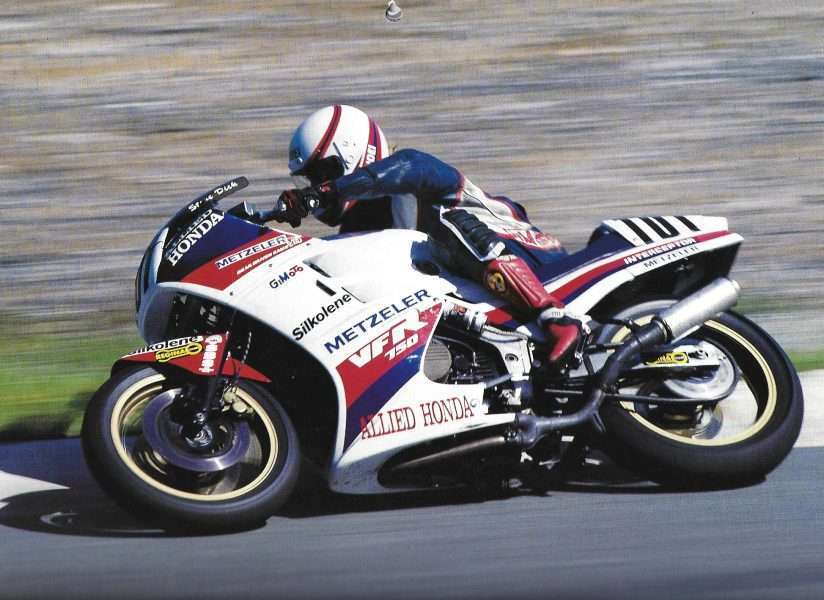
Dick started getting serious again in 1987, now riding for Allied Motorcycles, a Honda dealer where he again served as Service Manager.
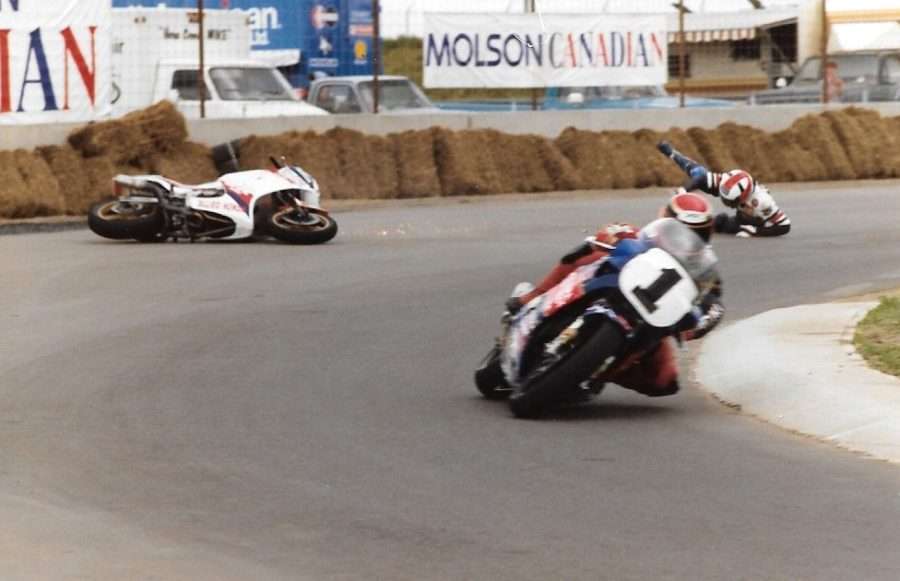
“We built our first Honda V-4 Superbike, and Tom Walther had one too. Tom was racing in the US and showing well and started to get back door support from American Honda. He eventually got two sets of the impossible to find works carbs, and he gave me his first set. And holly crap, did that wake my bike up.”
“Walther was travelling a lot, but I was mostly staying local. At the last National of 1987 at Shannonville, I think I crashed three times, not like me. Twice was on the Production Interceptor, it was a struggle with the tires at the time and that 16-inch front wheel.”
In Part Two of the Steve Dick story, we learn about Steve’s almost run to the 1988 National Superbike Championship, and success for Suzuki Canada including aboard the injured Miguel Duhamel’s works Mike Crompton Built GSX-R750s.