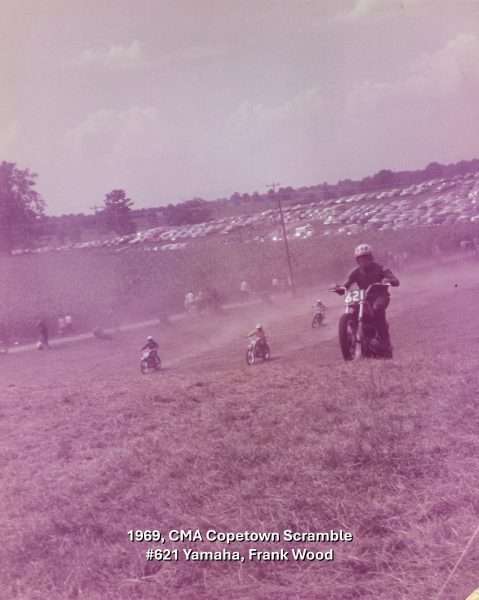
Frank Wood, Canadian Motorcycle Hall of Fame Inductee for 2025, has done it all, including hanging with Gary Nixon.

Best known as an event announcer or television host, and now headed for induction into the Canadian Motorcycle Hall of Fame at the Warplane Heritage Museum in Hamilton (Mount Hope) on Saturday, October 25, Wood took part in most aspects of two-wheeled competition in the wide-open era of the early 1970s – think “On Any Sunday,” but north of the border.
We sat down with Wood earlier this year in Belleville, close to his home, to discuss the career of the former “Inside Motorcycles” print version columnist.

Colin Fraser: What was your start in motorcycling?
Frank Wood: Age 16, when I bought a Lambretta Scooter from my cousin.
I rode it to and from school in Streetsville, to and from work at Tower’s Department Store.
During this time, I was diligently saving for a real motorcycle.
For years I told people that my first motorcycle was Honda CL160 Scrambler, and that is true, but I never admitted to the Lambretta!
I didn’t fancy being considered a Mod.
(Wood is referencing one of the major cultural issues of the 1960s in the U.K.: the mods (on scooters, especially Lambrettas) vs. the Rockers (on full size Birt bikes, especially Triumphs).
CF: What got you involved in competition?
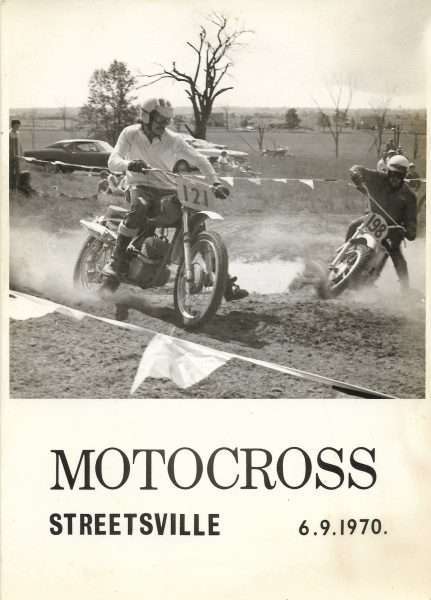
FW: There were a bunch of us riding motor bikes in High School, and a local Anglican Minister by the name of David Busby (also a keen rider, with a 250cc Matchless), he saw the proliferation of new Japanese motorcycles in our town of Streetsville – the High School parking lot would have 15 motorcycles, it was really cool.
I think it’s just the way the community of motorcycles works – you’re riding along the road, a friend pulls up, you accelerate, and you get into racing!
I had the good fortune to be raised on a farm in Mississauga, we didn’t own it, but we rented the farmhouse and had acreage available to us. We were able to stage races, and it was Busby that got us organized, we formed a club. We got CMA Affiliation, racing at the family place.
By then I had a Suzuki 80, there were S90 Hondas, Yamaha 80s, that type of bike – some of us were really into it, we even had knobby tires!

The Club did really well, with the guidance of Reverend Busby and our parents, we got affiliated, made sure we had insurance, got things set up right. I have to thank my family too, especially my dad, who was actually my uncle – my parents died when I was very young.
If I hadn’t been brought up where I was, in those circumstances, I wouldn’t have gotten into motorcycles. I set my brother up on his first ride when he was ten years old, and he worked for Flat Track Canada for years until he had health issues.
CF: What lead you to success in Flat Track?
FW: I have to blame that on Clive Kelly. I was working at Kelly’s Motorcycles in Brampton, and Clive was heavily involved in sponsoring Mo Fraser, I think Douggie Sehl rode for him, Dave Sehl too, and Clive a Fat Tracker as well, especially with TT racing.
My first racer was on a Yamaha DT1, it was a special one-year deal to showcase the new model, mostly with motocross, and I did that. I didn’t do that well, but I was the top Yamaha guy, and I ended up winning a Yamaha DT360. I flipped that bike to get a racer.
My bike had a 21-inch front wheel for motocross, a buddy of mine had the 19-inch front wheel, and we switched them, and I rode at the Belleville Flat Track race, with no acclaim. But then I was hooked, that was great fun.
There were no local flat tracks for me, so Belleville became my home track. That was all CMA sanctioned stuff, and Welland of course.
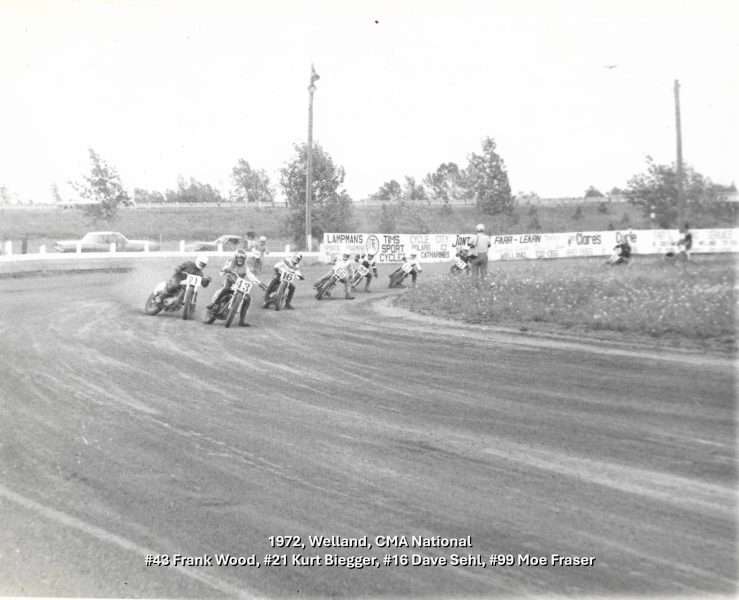
I made it directly from Junior into the Expert ranks and came close to the number one plate one season. A lot of that had to do with the top racers, people like Mo Fraser, the Sehl Brothers, David McLean, they were racing in the states much of the time. Then they would come home and beat the “you know what’ out of me!
One year I was running in second in the points standings for the number one plate, and I wound up fourth. 1973 or 1974, because 1975 was my last year.
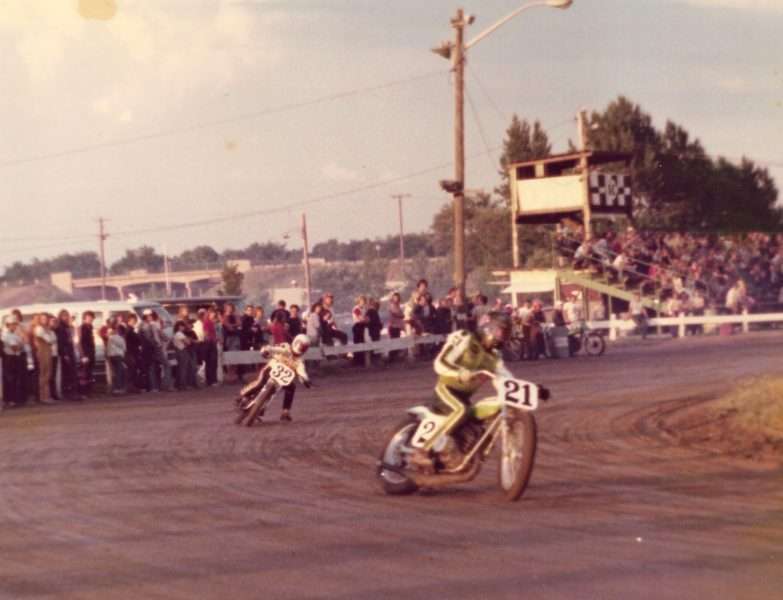
I went through a cycle of three years when I would work like hell all winter long, get as much overtime as I could and what have you, start off the season with everything prepared and a clear credit card, and then end up the season up to my ears in debt with a worn out motorcycle and a worn out van.
Suddenly, the cycle didn’t work for me anymore, and I bailed out.
CF: What led to announcing at the races?
FW: I would have to blame that on the legendary Peter Grant (H of F Class of 2013). I was always a vocal fan, and I knew what was going on, and people around me would react to what I had to say – my comments.
As a result of that, Peter asked me to try announcing, and I said yes. I promptly called up Pat Gonsalves to give me some tips, and Pat told me something that I still use to this day.
Pat’s most obvious suggestion was always to look for the race within the race. That has served me well.
I first announced at Hyawatha Downs up in Sarnia. Peter had been the number one plate holder in Flat Track for a number of years, we were good friends, and he was organizing races.
Let me tell you a story about Peter and me:
Back in 1975, we were all out in Edmonton for the National Championships, and they were paying $ 5,000 in prize money. That was a lot. So, anyone who could make the drive was there, including top gun Doug Sehl, who had two Harley-Davidson XR750s.
Doug offered me a ride on that spare bike, and I had never ridden an XR750 (legendary racer) before. So, I jumped on that opportunity.
I don’t think the bike lasted two laps; I was running third when it expired – I was out of the Expert race.
Meanwhile, my regular ride, the Triumph I had done so well on, the bike that I won my first National on a Welland of all places, I loaned to Peter Grant when his Norton failed. Peter was a Senior, and he won that race going away on my Triumph.
In announcing, I didn’t get to do Flat Track in the US. I was involved in some controversy when I worked on calling the CMRC Canadian Flat Track Series, it turned out to be a bit of an outlaw effort.
CF: When did you start announcing road racing?
FW: That would be working at Shannonville; I was downsized at my day job and wound up working at the track. Bob Szoke was the race announcer at the time (late 1990s) but Bob had a conflict with his son Jordan racing Stateside at the time, and I had the chance to pick up the Shannonville gig, and I’ve been doing it on-and-off, ever since.
Some of the highlights really come from the unexpected. I’ll give you an example – Bob Sobering was a good flat tracker (no offence Bob) and was also dabbling in steel shoes and accessories for flat trackers. When he won his first and only dirt track race at Welland one night, he refused to give the chequered flag back – that was kind of cool.
The guy who was running the National Road race series here in Canada said I might have a job for you in the US (MotoST Endurance), and sure enough that door was open. He recognized talented people!
I imagine sometimes what I would be doing if these things hadn’t happened – I have asked my wife where would I be without motorcycles?
For sure, working at Daytona was a thrill, although I didn’t agree with how they did everything. I still had a day job at the time, and people would ask me, what were you doing last weekend, and I would tell them I was at a race in Kansas!
I got to meet a lot of really good people, made some good American friends, some of whom are suffering right now.
CF: What about working with living legends like the late Gary Nixon?
FW: There isn’t much that I can admit in public!
I remember shaking hands with Mike Hailwoond way back as Clive Kelly tried to take our picture at Daytona.
I remember sharing some time in a motor home with Gary Nixon and (MotoGP 250cc race winner) Jimmy Felice, some notorious partyers. Nixon always was a hero of mine, and I always wanted a Nixon Triumph, and I told him so. And Gary told me that I wouldn’t want a bike of his once he was finished with it!
I got to know Nixon at the road races, strange since our roots are both flat tracking. But Nixon was a particularly good road racer, and he was in the pivotal movie, “On any Sunday.”
The “On Any Sunday” era was prime time for motorcycle racing, and everybody wanted to be a racer – the number of people participating in the races increased considerably once that film was released.
It’s incredible to think that influence is from more than 50 years ago; lots of great times from that inspiration.