




With the introduction of the Can-Am Spyder in 2007, Bombardier Recreational Products (BRP) moved off the dirt and on to the asphalt, offering up a completely new and original three-wheeled concept that has proven to be a game changer for the powersports industry.
Drawing on the ease of operation offered by automatic / semi-automatic transmissions and the stability provided by its unique three-wheeled platform, Can-Am has succeeded where other manufacturers have failed; namely in enticing new riders to leave the confines of their car behind in order to experience the surrounding world in a way that only motorcyclists can understand. At the same time, the brand has also been instrumental in extending riding careers when physical limitations start to interfere with slow speed maneuvering on motorcycles. So, while not motorcycles by definition, Can-Am’s three-wheelers definitely play an important and growing role within the industry.
Following 18 years of focusing on the requirements of local street riders and long-haul highway tourers, for 2025 the team from Valcourt, QC is looking to once again up the ante, with the introduction of the Can-Am Canyon. Described as “adventure-ready” this latest three-wheel creation from Can-Am aims to take riders beyond paved surfaces and out into the world less travelled.
Given the Canyon’s potential to further advance Can-Am’s consumer appeal, Inside Motorcycles jumped at an invitation to travel to Prescott, AZ to attend the North American press launch of this new model.

Seeing the Canyon in person for the first time, leaves no doubt that this model is unlike any of the others in the Can-Am lineup. The increased ground clearance of 160 mm (6.3 in), tall stance and shortened front body work gives the Canyon a rugged visual all unto itself.
Having the fleet of Canyons lined up in front of the hotel in advance of our schedule ride provided a chance to see each of the three available trim levels.
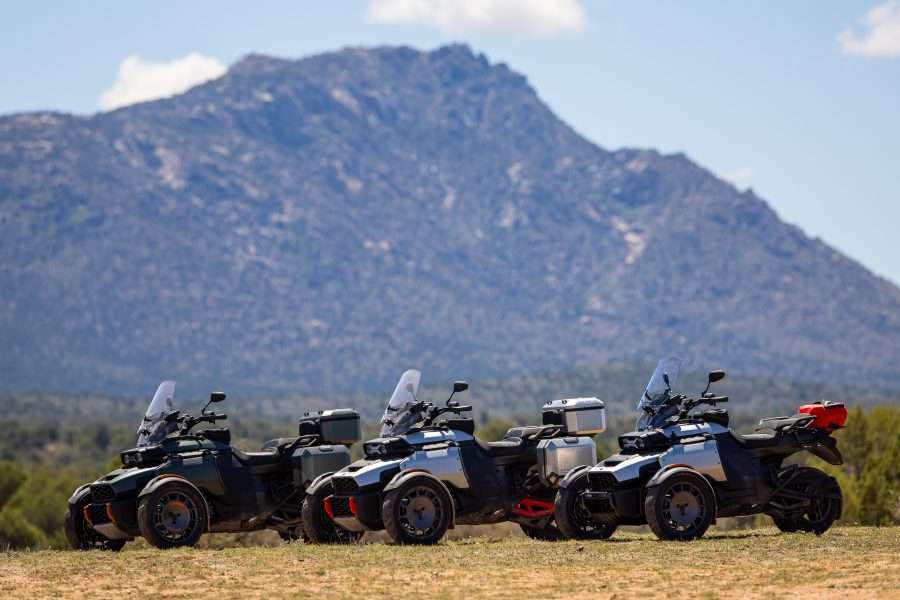
Using the term “base” model is a bit misleading in this case, as the entry level Canyon includes a number of premium features including Brembo brakes, a 10.25 inch full colour touch screen display complete with Apple CarPlay, selectable ride modes, traction and stability control, dynamic power steering, LED headlights, cruise control and 21 LinQ attachment points.
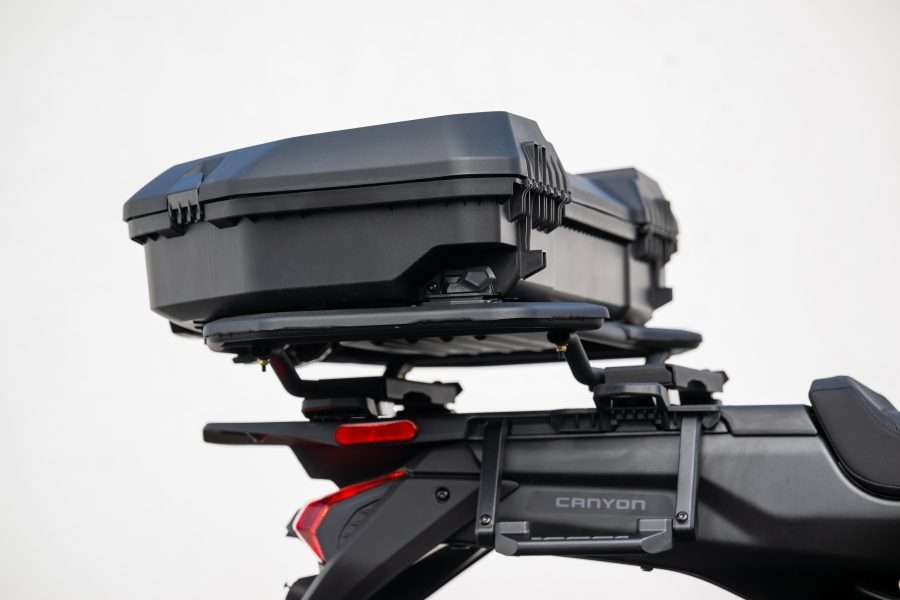
The LinQ system provides a wide variety of options including tanks bags, storage racks, cargo boxes, coolers and more, allowing Can-Am owners to customize their vehicles capacity to meet their unique needs.
Located above the display, a thin glove box, large enough to safely contain even the largest cell phones, is home to the USB port to connect to Apple Car Play. For Android users, Can-Am is actively pursuing a solution and in the interim you can still connect via Bluetooth to access music and phone.
The XT model adds in hard aluminum paniers and top case with 120 litres of combined storage. One of the downfalls of the Canyon’s shortened front bodywork is the loss of the front trunk that Spyder owners rely on when traveling or making runs to the grocery store, so the XT’s storage will definitely get utilized. The cases are locked and unlocked using the same key as the ignition. A skid plate and heated grips for both rider and passenger round out the upgraded features of the XT.
While the most easily notable difference with the top-of-the-line Redrock model is the Moss Green Satin colourway (the base and XT models are coloured with a Sterling Silver Satin finish), the big upgrade is the addition of the KYB Smart-Shox semi-active electronic suspension system that continually monitors rider input and chassis response to adjust compression and rebound settings in real time. The inclusion of a backup camera on the Redrock may seem somewhat gimmicky but actually proved to be useful when navigating out of a parking spot after lunch. The Redrock also receives an additional custom ride mode, colour-matched cases, custom stitching on the seat (both rider and pillion are also heated by the way) and upgraded powder coat finish on the front wheels.

Jumping aboard a Canyon XT for the morning’s travels, the riding position is both upright and comfortable with the large oversized footpegs located directly beneath the rider and the 143 mm (5.6 in) handlebar riser bringing the bar easily in reach whether the rider is sitting or riding.
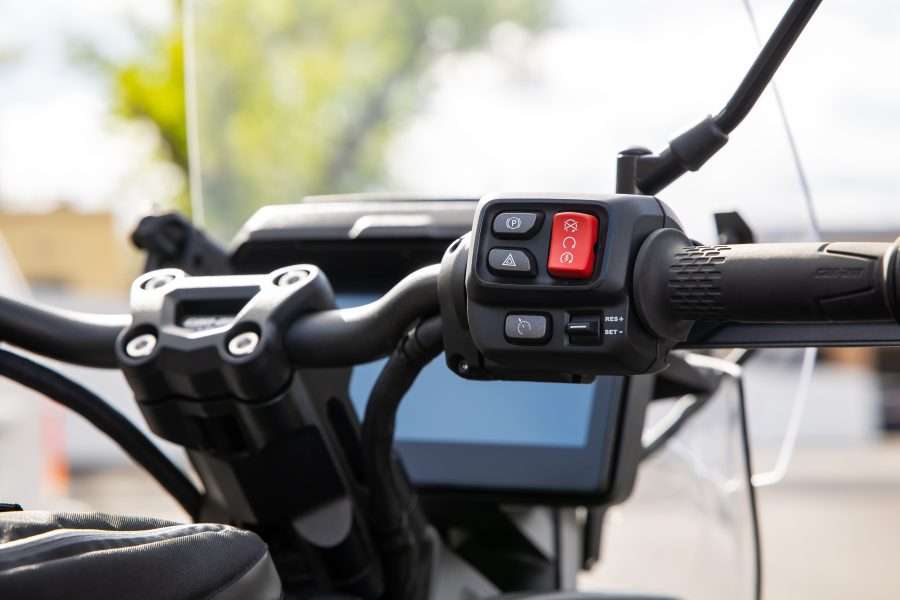
As with all Can-Am three wheelers, start up (and other operations such as setting the parking brake or shifting into reverse) requires cracking the code. With the Canyon, the mystery step requires rolling the throttle forward to move past the warning notice that appears on the screen every time the ignition key is turned on. With this exercise out of the way, it was time to head out for a ride.

No matter how many times I ride one of Can-Am’s three wheeled machines, that first turn always catches you off guard as the vehicle pitches to the outside of the corner. While the sensation is there on the Canyon it is definitely more muted, due in large part to the presence of the SACHS Big-Bore front shocks (10.2 in of travel) and SACHS rear shock (9.2 in of travel) that are standard equipment on the base and XT models. This benefit continued throughout the day as the Canyon feels more planted than other Can-Am on-road models especially during aggressive cornering.
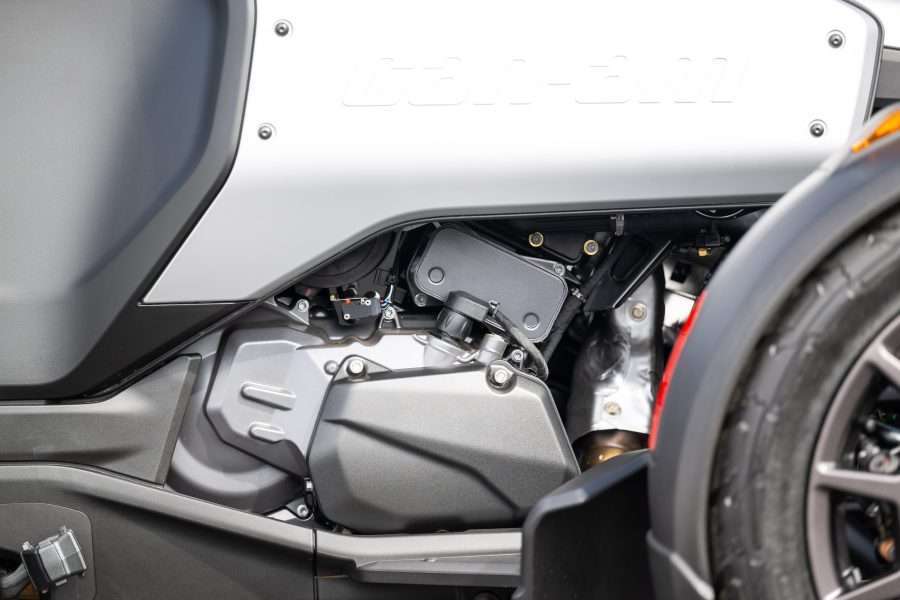
Built off the existing F3 platform, Spyder riders will be familiar with the 1,330 cc in-line triple Rotax engine (115 hp @ 7,250 rpm and 96 ft-lb of torque at 5,000) and six-speed (plus reverse) semi-automatic transmission combination that seemingly defies the fact the XT and Redrock models tip the scales at 470 kg (1,036 lb), pulling hard from both stand still as well as roll on. Upshifts are made using the thumb lever by the left grip that is conveniently reachable from both sitting and standing riding positions. Shifts are tight and immediate with no noticeable lag between input and actual shift. The transmission will auto downshift of if preferred this same lever can be used for downshifts. The auto downshift feature is good, but I found that in certain situations the system waits until a very low rpm range before downshifting and setting up to pull out of tight corners required rider-instigated downshifts to maintain optimal engine speed.
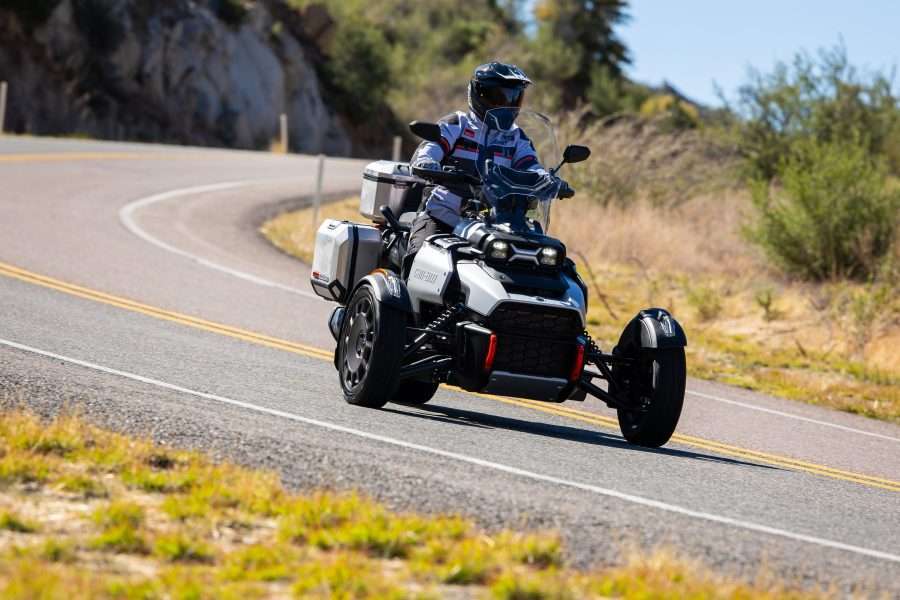
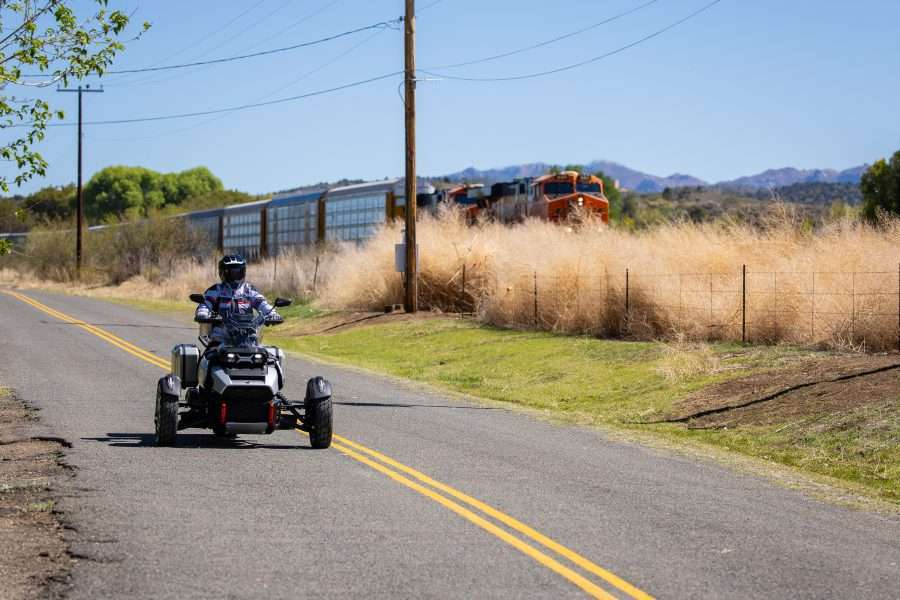
The initial stage of the ride took us west along the pristine windy highway towards to the small town of Skull Valley. At highway speed, the ability to adjust the windscreen height proved very useful as I was able to position it at the optimum height to minimize wind buffeting. The simple twist knob mechanism was easy to use and is certainly something that other manufacturers could consider for their adventure bikes.
In addition to taking in the sprawling scenery, it was a perfect opportunity to test out moving between each of the four drive modes (Normal, All-road, Rally and Sport). Easily accessed and changed on the fly via the buttons situated by the left grip, each ride mode adjusts suspension, power steering, throttle response and level of traction control. Within each ride mode, the operator has the ability to further fine tune each item, however they are not retained and need to be reset each time the Canyon is restarted (the Redrock includes an additional mode which allows riders to create and save their own custom ride mode). While the changes were negligible on the highway, the ability to reduce traction control and other interventions and allow for some rear wheel spin in the Rally mode, would come in handy once we headed off -road.
On the subject of off-road, Can-Am is very specific that while the Canyon has been designed and built to handle gravel roads, it is not intended to be used in off-road situations such as dual- and single-track trails. With this in mind I will refrain from using the phrase off-road.
Following a photo stop in Skull Valley, our route took us north and into the Prescott National Forest, where it was time to let the Canyon stretch its off-pavement legs. Riding along windy gravel and sand roads, the XPS Adventure tires (K155/65 R16 front and K225/50 R16 rear), held firm with minimal slippage and when required, the Brembo brake package (270 mm discs with four-piston calipers up front and a 270 mm disc with single-piston caliper rear) was smooth and precise. It did take a few minutes of reaching for the non-existent front brake lever before getting used to the single brake pedal that operated the linked brake system. The suspension took this opportunity to shine as it kept the Canyon online over ever-changing surfaces that included loose gravel, sand, washboard and deep ruts. I took the opportunity to once again work through the various ride modes and not surprisingly Rally mode provided the most notable change in performance mostly in throttle response and reduced intervention from the ABS and traction control systems.
Out of habit, once the route headed onto non-asphalt surfaces, I found myself standing on the oversized footpegs. Unlike a motorcycle, given the weight of the Canyon as well as the physics of the three-wheeled set up, there is limited ability to impact the vehicle with weight transfer, but the standing position stilled proved useful. Thanks to the well orientated handlebar and footpegs, as well as the purposeful narrowing where the front of the seat meets the tanks, this riding position feels natural and provides an excellent perspective for off-pavement navigating.
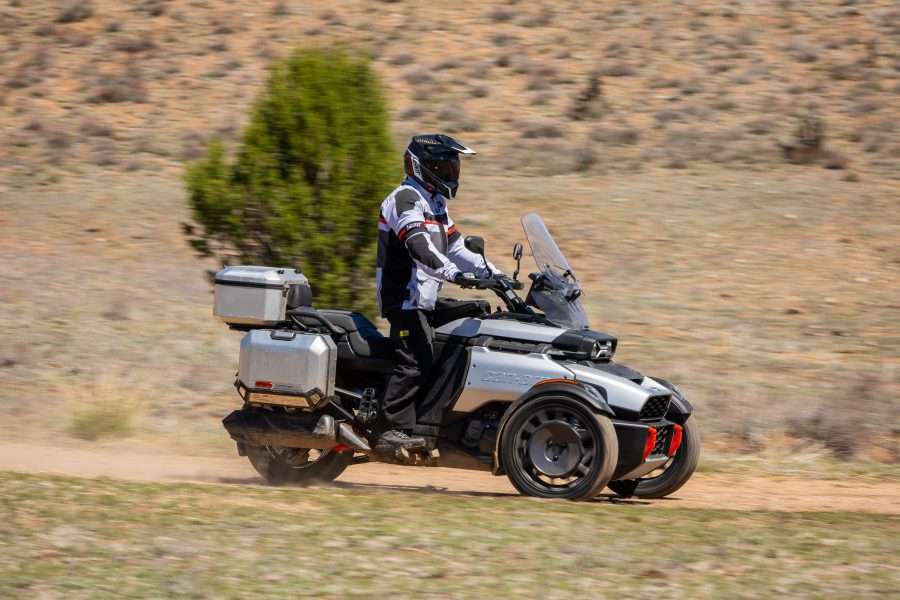
The footpegs have removable rubber inserts and removal of these is a must when travelling through wet and muddy conditions. After riding through a muddy section of road, I was surprised to find the peg (with the rubber insert still in) was extremely slippery when I moved that foot. Removing the rubber inserts took less than 60 seconds and immediately rectified the situation.
After a lunch stop, it was time for more off-pavement riding and this is where the adventure kicked into high gear. Where the morning’s dirt sections had been relatively flat, the afternoon’s included dramatic climbs on winding, red dirt roads that at times narrowed to a point where the Canyon’s 1,581 (62.2 in) width was definitely limited to one-way traffic. I had switched to the Redrock model for the afternoon’s ride, but the road was so much more aggressive in the afternoon that it was hard to compare it to the morning’s ride on the XT. This same area also included stretches with large rocks strewn across the surface and some substantial ruts both of which the Canyon’s ground clearance handled with no issues.
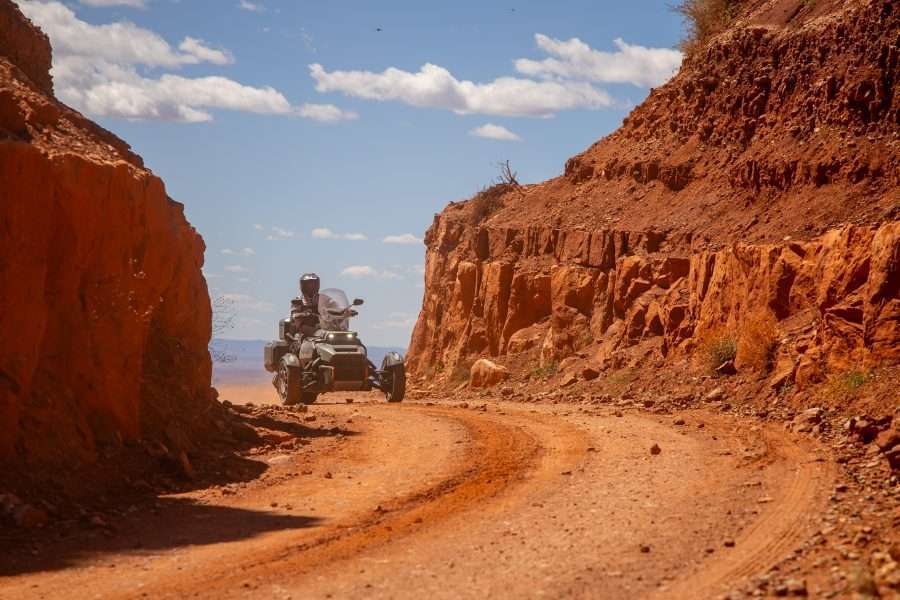
The ride back down the mountain eventually brought our group to another section of winding asphalt, complete with switchbacks that confirmed the Canyon’s ability to push hard and remain stable, with less body roll than other Can-Am three-wheeled vehicles.
The final stretch of our ride provided an opportunity to assess the Canyon’s freeway manners and it was easy to find yourself daydreaming about taking it on a ride across the country. In addition to its performance on gravel and all the other road surfaces we had just experienced, on the freeway the Canyon was smooth and handled easily with the cruise control keeping it at a steady pace. Knowing that owners of the Canyon will likely rack up substantial highway miles, the inclusion of an adaptable cruise control would be a recommended feature for Can-Am to consider for future models.
Of course, anyone reading this review is probably sitting on two questions. First, is the Can-Am Canyon something they should consider for their next purchase? And secondly, how much will it cost?
Like all Can-Am three wheelers, the Canyon offers new and aspiring riders the opportunity to get out the open road with a vehicle that they may find easier to operate than a motorcycle. The same goes for seasoned riders who are struggling with the weight and balance of their current motorcycle, or for those who simply want to try something different. There are also passengers to consider. My wife is simply not comfortable riding two up on a motorcycle but has happily done rides and tours on Can-Am Spyders where she finds the lack of lean angle reassuring. With the added versatility of the Canyon, if you have been considering a Can-Am three-wheeler, this may be the time for you to take the plunge.
When it comes to price, the Canyon lineup follows falls fairly much in line with the rest of the Can-Am stable. At $30,999 the base model Canyon comes in between the base models of the Spyder F3 and Spyder RT lineups. Similarly, the Canyon XT’s MSRP of $36,999 falls between the F3 and RT Limited Models. The $40,499 price tag on the Canyon Redrock is definitely not for the faint of heart but given the success of the Spyder Sea-to-Sky model and its almost identical MSRP, there is definitely a market for these premium machines.
So, is the 2025 Can-Am Canyon right for you? As always that is a personal decision that can only be made after weighing multiple factors, however if you are interested in a Can-Am, whether it be your first three-wheeled vehicle or if you are looking to upgrade, the Canyon is definitely a worthy contender.
2025 Can-Am Canyon
- Suggested Retail: Starting at $30,999 (base model)(XT: $36,999, Redrock $40,499)
- Colours: Sterling Silver Satin (Base and XT), Moss Green Satin (Redrock)
- Engine: Liquid-cooled, three-cylinder
- Displacement: 1,330 cc
- Bore & Stroke: 84 x 80 mm
- Power: 115 hp @ 7,250 rpm
- Torque: 96 ft-lb @5,000 rpm
- Fuel Delivery: Fuel injection
- Weight: Base 452 kg (996 lb) wet, XT and Redrock 470 kg (1,036 lb) wet
- Transmission: Six speed, semi-automatic with reverse
- Wheelbase: 1,718 mm (67.6 in)
- Width: 1,581 mm (62.2 in)
- Seat Height: 843 mm (33.2 in)
- Suspension (front): Double A-arms with anti-roll bar, SACHS Big-Bore Shocks (Base and XT), KYB Piggyback Smart-Shox (Redrock)
- Suspension (rear): Swingarm with SACHS shock (Base and XT), KYB Smart-Shox (Redrock)
- Tire (front): XPS Adventure – K155/65 R16
- Tire (rear): XPS Adventure K225/50 R15
- Brakes (front): 270 mm discs with Brembo four-piston calipers
- Brakes (rear): 270 mm disc with single-piston caliper
- Fuel Capacity: 27 L


Discussion about this post