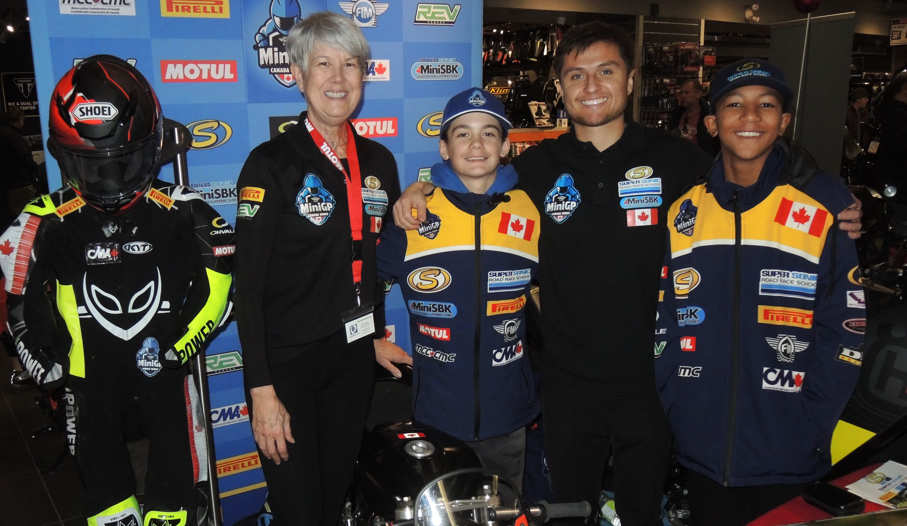
At GP Bikes recent Christmas Open House, a busy crowd visited with a number of celebrities while shopping. David Hatch, the host of TSN’s “Motorcycle Experience,” was joined by Mini Cycle Road Racing czar Toni Sharpless and her lead instructor, Yamaha Motor Canada’s Bridgestone CSBK Superbike star “T.V. Tommy” Casas.

We took a few minutes to visit with Toni and Tommy at Oshawa’s big bike shop and get their overview of the MiniGP World Championships held during a cold and busy week in the inland mountains of central Spain beside Alcaniz.
Inside Motorcycles: Toni, what is your key take away now that you have had time to digest everything that happened at the Aragon Go-Kart track once we’d been moved from Valencia on short notice due to the flooding?

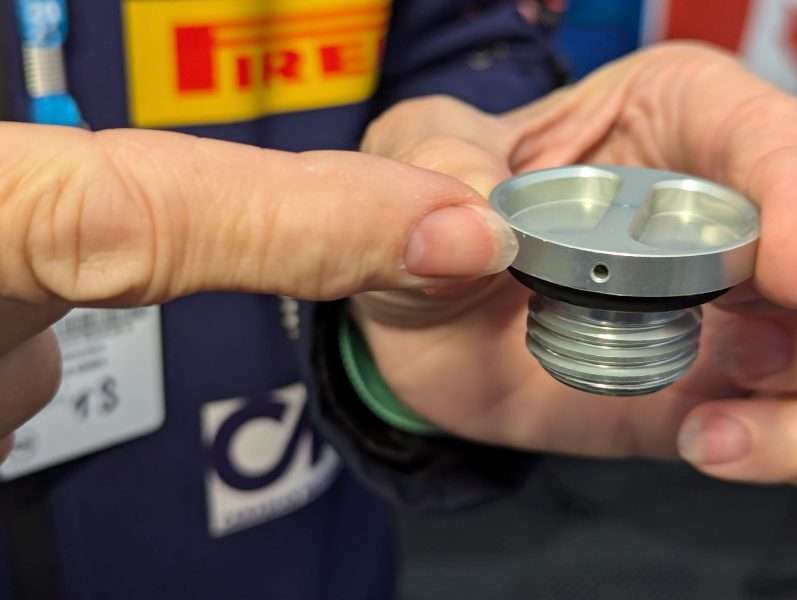
Toni Sharpless: I’m happy – we’ve moved the needle a little further toward the front of the pack, and the crew we had over there this year worked really well together – I was happy to see that. There was lots of action in the paddock due to the weather, water in the fuel systems, figuring out how to get the tires warm, various adjustments in the structure that proved to be a challenge relating to that weather.
Tommy Casas: My thoughts are like Toni’s – happy to see that needle move in a positive direction for the Canadian Team. Last year, I think Toni was shocked about how our team compared to the rest of the World. For me, having a background of attending the Red Bull Rookies Cup early in my career, having seen that calibre of talent, I was realistic about what we were up against. I didn’t have my hopes way up last year, in terms of placing riders into the final.
This year, I was on the borderline – I thought there was a chance we just might make it in. The talent pool in Europe in particular is so deep, and we just can’t compare – not yet. We don’t have that experience, yet. I was glad to see how close we got this year.
The rain played to our advantage; in term of some close calls, and Lincoln (Scott, 2024 Motul Ohvale 160 MiniGP National Champ) had a good opportunity of making it to those final three race on Thursday.
TS: Lincoln is up for a challenge – I have seen that from his in the pat two years, in a wide range of circumstances.
TC: I’m seeing that there is progress, and we are on the right path – we just need to give these kids the opportunity to ride more, then we can get them into those finals. We need more track time, and more racers to compete against.
IM: The qualifying structure is confusing at the World Finals, with some racers transferring directly and others having to race their way in, all complicated by rain and the switch to the spec Pirelli rain tires for most of Wednesday’s action. In terms of results, you could argue that Scott was within a tenth or two of making the main events; is that a fair way to view things?
TS: If you go by the dry weather sessions, where conditions were by no means ideal and everyone was learning the track, I will say we were at least two seconds off the pace – a big gap. That is more accurate and fair.
TC: The one tenth of a second factor represents our chance to move up to the Q2 session, and who knows where we could have gone from there given the difficult conditions. We had that opportunity, and conditions were playing to our advantage. Not many of the other young riders saw as much rain as the Canadians deal with over the course of our season in Canada.
IM: Under the big Talent Cup tent where all the racers were based in the paddock, it seemed like Scott and our number two, Jager Stockill, were far more optimistic in the difficult conditions that many of the other top racers from the other invited countries?
TC: The biggest thing in the dry for us was that our team didn’t have the experience of dealing with a track that big, those speeds; especially with a racer like Jager.
Jager just doesn’t have the kind of experience that a racer like Lincoln has developed, and there is no substitute for time. Scott was more prepared overall and had the attitude to excel in the rain. I have done well in the rain, and the mental approach is a big part of that in slippery conditions: “am I going to let this get to me?”
Rain is the great equalizer, and we worked to make the most of that. With our kids, their experience helped, but the attitude is the main component.
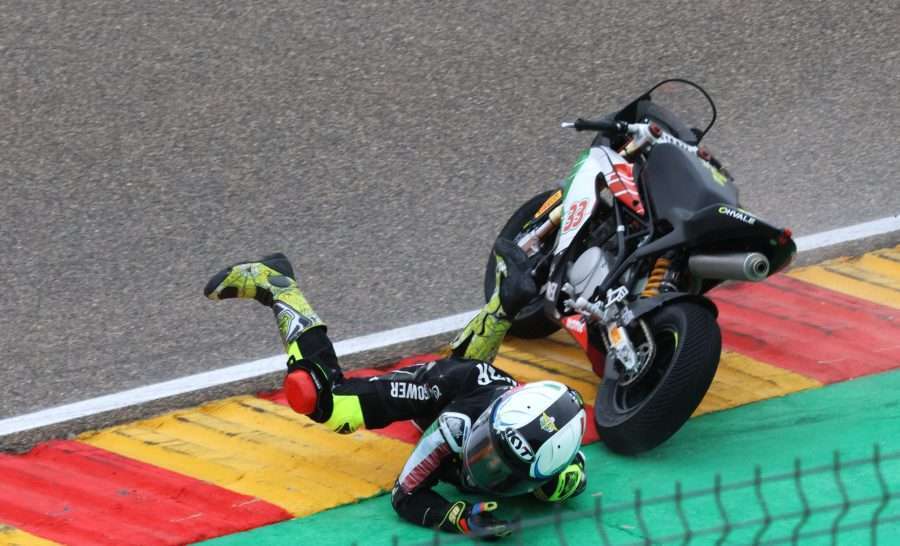
TS: I think our guys might have had a slight advantage, we had lots of rain in practice and racing during the 2024 season. Tomas did an excellent job of keeping the kids calm, and their minds focused. Both our riders were prepared, engaged, and were comfortable they could do it. Some of the teams were panicked, and that was sometimes because they don’t race in the rain – it doesn’t rain!
(As an example, the Australin racers had no wet experience, although obviously Australia is not a completely arid country, certainly not on the coast where most of the tracks are located.)
For instance, you have to keep in mind that this was the first year of racing for Jager and before that he took part in a couple of motocross races. Jager rides really well, but Lincoln could bring a lot more in response to the challenges. Scott was really charging in the rain, he gathered up the fast group, and had one carousel turn mastered in a way that no one else matched in the early going.
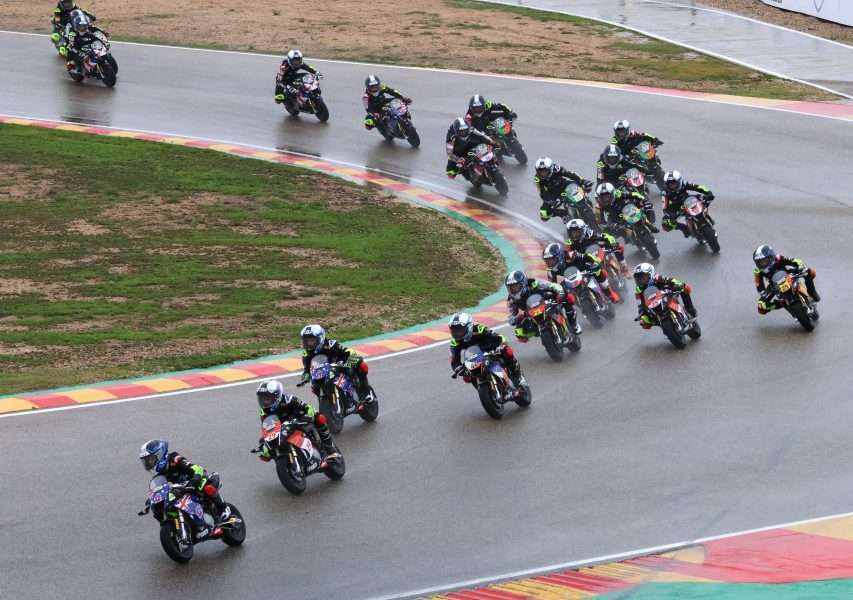
IM: The Aragon track was so much bigger and faster than the “mirrored” track at Valencia, a shrunk down version of the MotoGP venue across that paddock. This meant some people figured that the racing would not be as close this year, but even with the drying track and the field on rain tires (in five of the six final races), the level of competition and standard of riding was exceptional.
TS: They were on rain tires as the track dried, and it got very dry – and they were pushing those tires hard, and the tires were standing up well on the almost dry track. The speed difference is noticeable, how fast the bikes are going.
Tomas explained during the track walk how fast things would be, and where the likely passing spots might be, if you got a drive and timed your move – something you couldn’t do in Valencia. Our kids a little bit behind in some of those spots, but they made strides and were catching up.
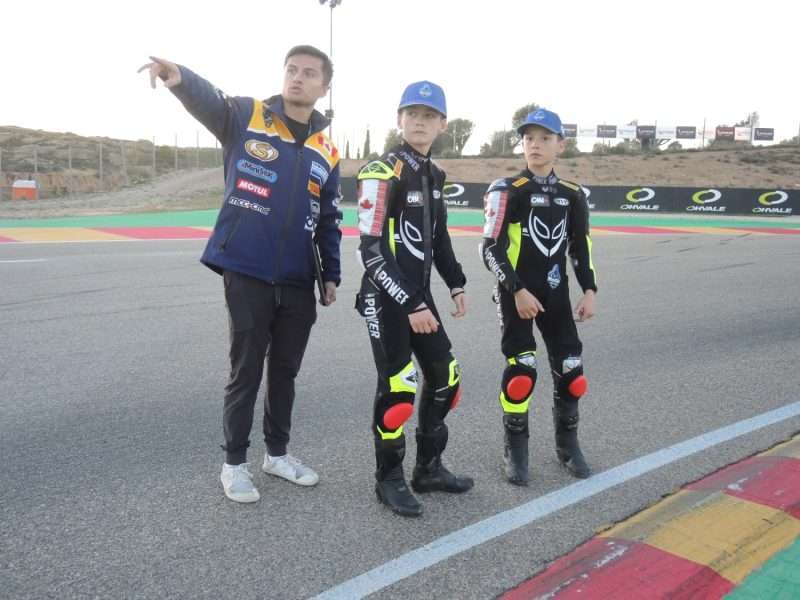
We are learning each year, from our trips to Europe, and developing the teaching methods we will need for the next generation of MiniGP competitors. We will prepare them for a better effort, more performance, at the World Championships next year.
TC: What was shocking was to see the 160cc racers (smaller displacement and smaller ten-inch wheels) and view their race craft – it was like watching a Superbike race. Kids that are 10 or 11 years old, and they have a level of race craft that I am still developing! Their comfort level to enter a corner four abreast, and do it corner after corner, back and forth, back, and forth.
For sure, you think one guy will make a move, and then take down two or three others, it was so close. But everyone would slot into their spot, respect the other riders, and plan their passes.
The track allowed a really high, prestigious level of racing, a real showcase. The way the pack could get organized in the slippery conditions and hunt down the leader, it was amazing. Last year’s track favored getting the hole shot and taking a defensive race line – this track was nothing like that, and I hope we can go back.
Our team are lacking that comfort level: riding and pushing, getting inside of each other, rubbing elbows, having two or three racers beside you. We need to get comfortable riding like that, at such an early age.
TS: Our application is in with the FIM to stage the Series in 2025 and send a team to the World Finals for the FIM. I count twenty kids and families who have expressed interest, and its only early December. I think we will pick up momentum each year.
This year’s event was really a great showcase for the racers and the Ohvale machinery.